Key takeaways
- Compare payroll software on total cost, the subscription plus the hours your team still spends, not on the price per employee alone.
- In small companies the person running payroll is often the founder, so each hour costs far more than an HR hour.
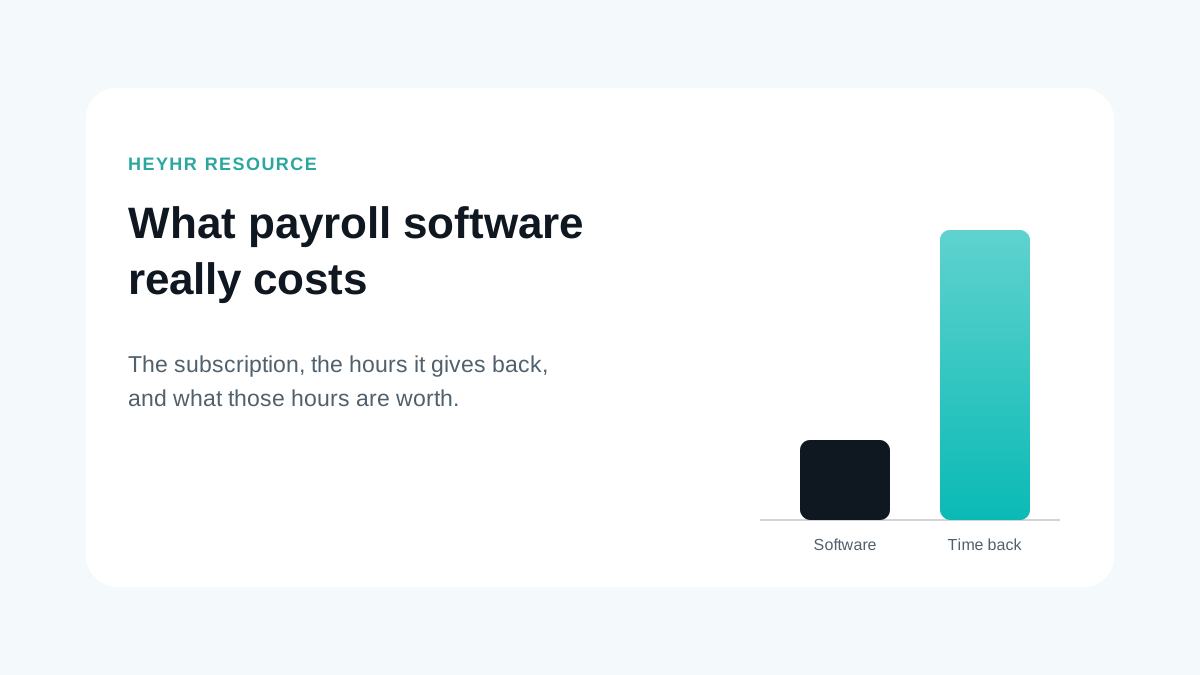
- In the examples below, the value of time given back ranges from about 1.2 times the subscription for a 50-person company to almost 6 times for a startup.
- Every extra country adds a separate payroll, separate rules and a separate filing calendar, so groups gain the most from one system.
- Late statutory payments carry direct costs too, like 1.5% a month on late CPF and a 5% surcharge on late MPF, which these examples do not count.
Why the price per employee is only half the picture
Payroll software is usually compared on one number: the price per employee per month. That number matters, but it leaves out the larger cost, the hours someone in your company still spends getting payroll right.
Those hours go into preparing inputs, checking CPF or MPF, approving leave and claims, answering "why is my pay different this month?", and producing payslips and filings. Somebody does that work, and it has a price.
So a fair comparison has two halves:
| What it is | How to estimate it | |
|---|---|---|
| Subscription | What you pay the software provider | Price per employee × headcount, with any minimum fee |
| Time | Hours your team spends on payroll and HR admin | Hours a month × that person's monthly cost ÷ 173 |
How we estimate the time
We use simple estimates you can replace with your own:
- Time today: about 6 hours a month for each country you pay in, plus 0.8 hours per employee for payroll prep, leave, claims, questions and paperwork.
- Time given back: the share of that time the software takes over. We assume 50% for payroll alone, 60% with HR apps, 65% with an AI agent, and 75% with all three.
- Value of an hour: the monthly cost of the person doing the work, divided by 173 working hours.
These are estimates, not promises. Your own numbers depend on how you work today.
Example 1: an eight-person startup in Singapore
The founder runs payroll, CPF and leave in the evenings. A founder's time costs about SGD 15,000 a month, or roughly SGD 87 an hour.
| Per month | |
|---|---|
| Time on payroll and HR admin today | about 12 hours |
| HeyHR Complete (8 × SGD 17) | SGD 136 |
| Time given back (75%) | about 9 hours |
| Value of that time | about SGD 780 |
The founder gets back about a working day each month, worth almost six times the subscription.
Example 2: a 50-person company in Singapore
One HR executive, costing about SGD 5,000 a month including CPF, handles payroll, leave, claims and employee questions.
| Per month | |
|---|---|
| Time on payroll and HR admin today | about 46 hours |
| HeyHR Complete (50 × SGD 17) | SGD 850 |
| Time given back (75%) | about 35 hours |
| Value of that time | about SGD 1,000 |
Here the value of time is about 1.2 times the subscription. The bigger gain is what HR does with almost a week a month: hiring, reviews and the questions that need a person.
Example 3: a group across three countries
Singapore has 40 employees and Hong Kong has 15, each with its own payroll. Vietnam has 20 more employees whose pay is run locally but who need to be in the same record. One HR manager, costing about SGD 7,000 a month, holds it together.
| Per month | |
|---|---|
| Time on payroll and HR admin today | about 64 hours |
| Singapore (40 × SGD 17) | SGD 680 |
| Hong Kong (15 × HKD 100, about SGD 259) | about SGD 259 |
| Vietnam on Global HRIS (20 × SGD 2) | SGD 40 |
| HeyHR in total | about SGD 980 |
| Time given back (75%) | about 48 hours |
| Value of that time | about SGD 1,950 |
The value of time is about twice the subscription. Each country adds its own rules, its own calendar and its own filings, which is why groups gain the most from running them in one system.
What these examples leave out
The examples count time only. They leave out the direct costs of getting payroll wrong:
- Late CPF: late payment interest of 1.5% a month from the day after the due date.
- Late MPF: a surcharge of 5% of the outstanding contributions.
- Late AIS: in Singapore, employment income must reach IRAS by 1 March each year, and late submission can lead to a fine.
They also leave out the time saved at audit and year end, when every figure has to be explained.
How to run the numbers for your own company
- Count employees by country.
- Estimate the hours a month your team spends on payroll and HR admin, or use the estimate above.
- Put a monthly cost on the person doing it, including CPF or MPF. If it is the founder, use what their time is worth.
- Compare the subscription with the value of the time it gives back.
Questions
How much does payroll software cost in Singapore?
Most payroll software for small and medium companies in Singapore is priced per employee per month, typically from about SGD 4 to SGD 6 for payroll alone. HR apps and AI features are usually priced on top.
How do I compare payroll software fairly?
Add the subscription to the hours your team still spends on payroll and HR admin each month, valued at what that person costs. The cheapest subscription is not always the lowest total cost.
How much time does payroll take a small company?
It depends on headcount, pay complexity and how many countries you pay in. A rough starting point is about 6 hours a month per country, plus just under an hour per employee for payroll prep, leave, claims, questions and paperwork.
Is payroll software worth it for a startup?
Often yes, because the person running payroll is usually the founder. Even a few hours a month of founder time is worth more than the subscription for a small team.
Sources
- CPF Board — When is the due date for CPF contributions?
- MPFA — Enforcement measures and penalties
- IRAS — Auto-Inclusion Scheme (AIS) for Employment Income
This guide is general information, not legal or tax advice. Check the official sources for your situation.