Key takeaways
- Most Singapore payroll mistakes do not begin with one wrong number. They begin with fragmented rules, records, and execution.
- Growing companies often miss CPF updates, treat AIS too late, and handle exceptions outside the system.
- Weak payslip, salary record, and SDL discipline can turn small process gaps into larger compliance and reporting issues.
- The deeper fix is not only better checking. It is a payroll operating model that brings knowledge and execution together.
Why payroll mistakes in Singapore are rarely just about one wrong number
Payroll mistakes in Singapore are rarely just about one wrong number.
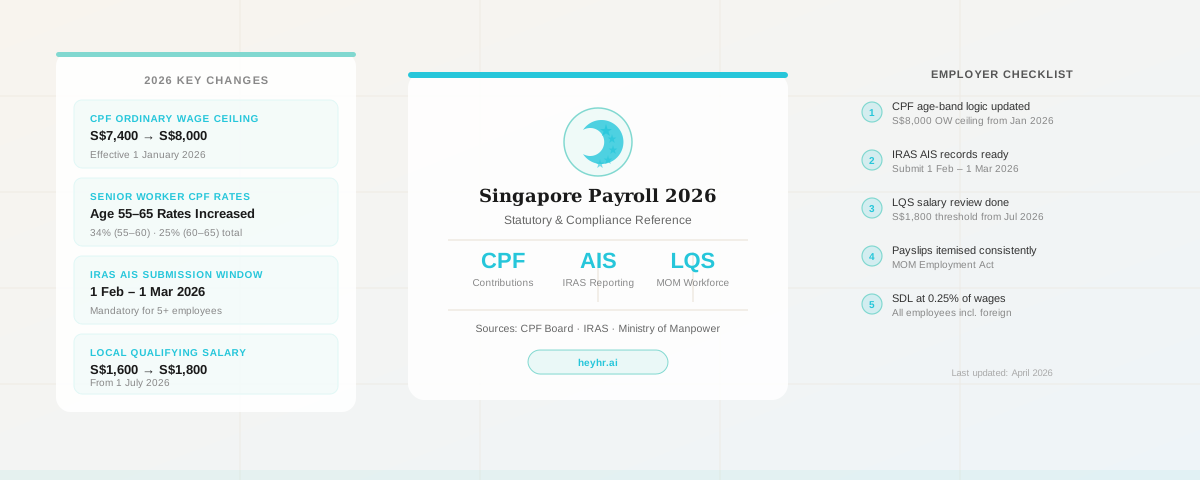
More often, they happen because payroll sits across statutory rules, reporting obligations, and day-to-day execution. Employers may need to manage CPF correctly, prepare for IRAS Auto-Inclusion Scheme reporting, issue itemised payslips, maintain salary records, and pay Skills Development Levy. In 2026, they also need to reflect the CPF Ordinary Wage ceiling of S$8,000 and the latest CPF contribution changes for employees aged above 55 to 65.
Mistake 1: Using outdated CPF settings
One of the most common payroll mistakes is continuing to run payroll with old CPF assumptions.
From 1 January 2026, the CPF Ordinary Wage ceiling increased from S$7,400 to S$8,000. CPF contribution rates also increased for employees aged above 55 to 65. If payroll settings were not updated, both employer cost and employee deductions could be wrong even if salary figures themselves did not change.
Mistake 2: Treating AIS as a filing task instead of a data quality test
Many employers still treat AIS as something to deal with at the end of the cycle.
But IRAS requires AIS employers to submit employees’ employment income information electronically by 1 March each year, and late submission can lead to a fine of up to S$5,000.
Mistake 3: Assuming payslips and salary records are just admin formalities
Some employers think payslips and salary records are compliance basics that can be handled loosely.
MOM requires employers to issue itemised payslips and maintain salary records. Weak records make disputes, reporting, and payroll explanation harder later.
Mistake 4: Overlooking SDL because it seems small
SDL is one of the easiest employer obligations to underestimate. Small repeated misses can weaken payroll discipline over time.
Mistake 5: Letting exceptions live outside the system
A lot of payroll complexity does not come from standard salary runs. It comes from exceptions such as bonuses, variable pay, off-cycle adjustments, resignations, and leave scenarios.
Mistake 6: Assuming payroll software automatically solves payroll knowledge
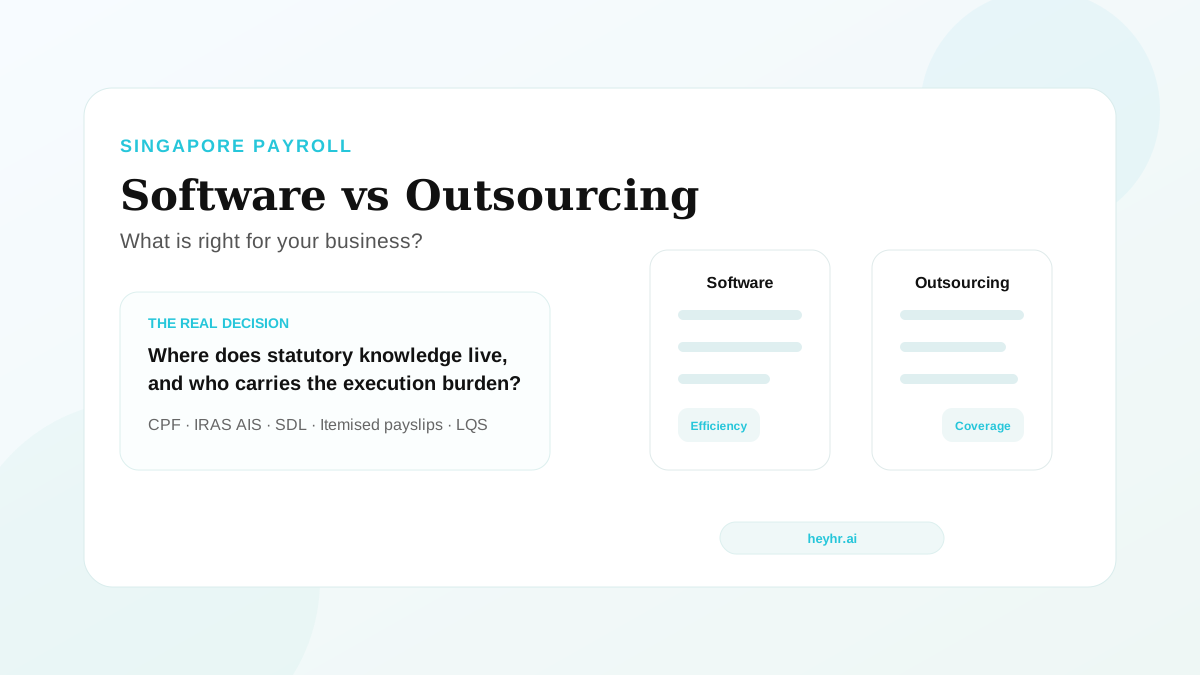
Payroll software can improve efficiency, but it does not automatically absorb statutory interpretation and exception handling.
Questions
What is the most common Singapore payroll mistake?
Running payroll with outdated CPF settings. From 1 January 2026 the CPF Ordinary Wage ceiling rose from S$7,400 to S$8,000 and contribution rates increased for employees aged above 55 to 65.
What happens if AIS is submitted late?
IRAS requires AIS employers to submit employment income information electronically by 1 March each year, and late submission can lead to a fine of up to S$5,000.
Does payroll software prevent payroll mistakes?
Not by itself. Many mistakes come from exceptions handled outside the system and from statutory knowledge the software does not carry. The fix is an operating model that keeps knowledge and execution together.
Sources
- CPF Board — Changes to CPF contribution rates for senior workers from 1 January 2026
- IRAS — Auto-Inclusion Scheme (AIS) for Employment Income
- Ministry of Manpower — Itemised payslips
- CPF Board — Skills Development Levy
- CPF Board — How much CPF contributions to pay
This guide is general information, not legal or tax advice. Check the official sources for your situation.