Key takeaways
- The 2026 Employer’s Return cycle in Hong Kong requires more than a year-end export. It depends on data readiness, record integrity, and correct classification of remuneration.
- Form BIR56A is the covering return, but IR56B is where the employee-level reporting work sits.
- Cross-border arrangements, non-Hong Kong entity payments, housing benefits, and fragmented records can make reporting much harder.
- IR56B season often reveals whether payroll is truly under control or still dependent on manual reconciliation outside the system.
For many employers, payroll in Hong Kong feels manageable during the monthly cycle but becomes significantly more demanding once annual reporting begins.
The Inland Revenue Department states that Employer’s Returns of Remuneration and Pensions (Form BIR56A) for the year ended 31 March 2026 were issued on 1 April 2026, and employers are required to complete and file the returns within one month, together with Form IR56B.
1. Filing starts with BIR56A, but IR56B is where the real work sits
Form BIR56A is the covering return issued to employers, but the employee-level substance sits in Form IR56B, which reports remuneration paid during the assessment period.
2. The scope of reportable remuneration is broader than many teams expect
IRD guidance makes clear that IR56B is not limited to base salary. The reporting scope covers salary, wages, leave pay, fees, commissions, bonuses, gratuities, allowances, and perquisites.
3. Cross-border arrangements make the reporting burden much heavier
Assigned or seconded employees, non-Hong Kong entity payments, and other cross-border arrangements can make annual reporting much more demanding.
4. Record readiness matters as much as filing readiness
Wage and employment record quality often determines whether IR56B season becomes smooth or turns into a manual reconciliation project.
5. Why this exposes the limits of both software and outsourcing
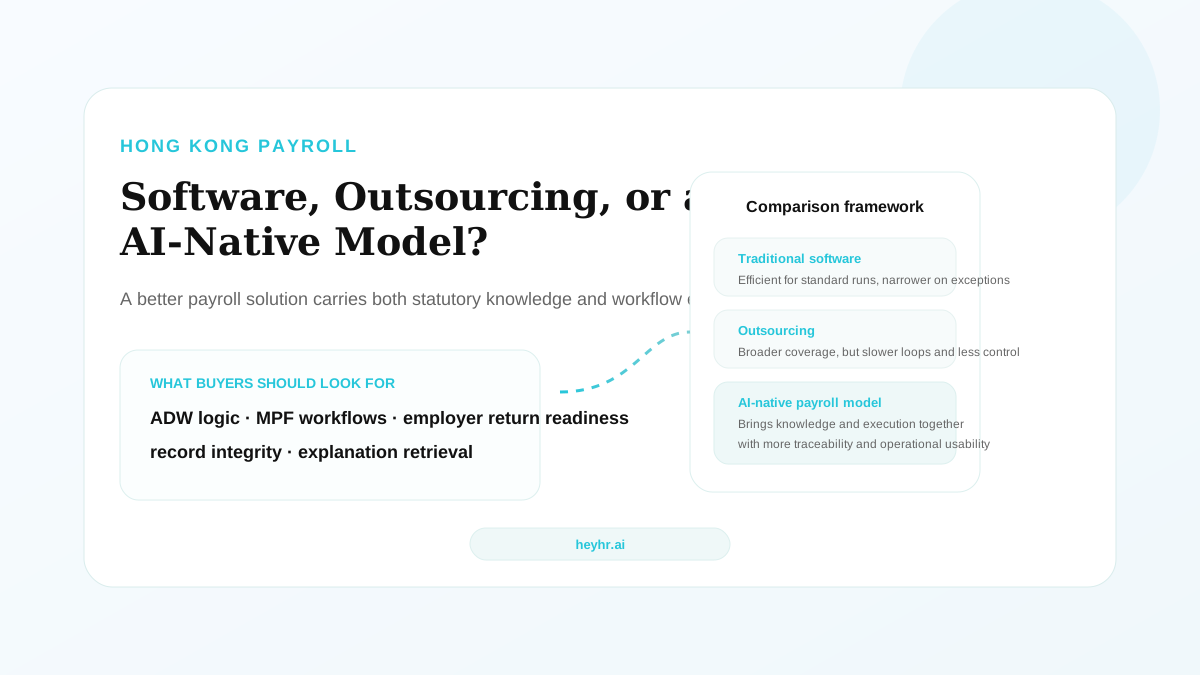
Traditional payroll software often automates the standard run, while outsourcing covers more complexity but at the cost of communication loops and dependency.
6. Who should care most about this
This article is especially relevant for SMEs, multi-entity organisations, and regional employers with more complex worker arrangements.
7. What payroll teams should prepare now
- Confirm which employees fall within the reporting scope for IR56B.
- Reconcile all categories of remuneration, not just basic salary.
- Review housing benefits and other non-cash benefits.
- Check whether any part of remuneration was paid by a non-Hong Kong entity.
- Validate employee movement records and employment dates.
The 2026 Employer’s Return cycle is a useful reminder that payroll in Hong Kong is not just a monthly pay run.
At HeyHR, we think payroll should help employers systemise the knowledge and execution around payroll so that annual reporting does not remain fragmented manual work outside the system.
Questions
When is the Employer's Return due in Hong Kong in 2026?
The IRD issued Employer's Returns (Form BIR56A) for the year ended 31 March 2026 on 1 April 2026. Employers must complete and file them within one month, together with Form IR56B.
What is the difference between BIR56A and IR56B?
BIR56A is the covering return issued to the employer. IR56B is the employee-level form that reports the remuneration paid to each employee during the assessment period.
What income must be reported on IR56B?
Not only base salary. The scope covers salary, wages, leave pay, fees, commissions, bonuses, gratuities, allowances and perquisites.
Sources
- Inland Revenue Department — Employer's Return
- Inland Revenue Department — Notes and Instructions for Form IR56B
- Inland Revenue Department — Notes and Instructions for Form BIR56A (PDF)
- Inland Revenue Department — Form IR56B (PDF)
- Labour Department — Proper Keeping of Wage and Employment Records
This guide is general information, not legal or tax advice. Check the official sources for your situation.